
An Interview with Librarian Amanda Hunt, Part 1: "This Has Been the Hardest Year of My Life."
On social media harassment, library shutdowns, and book censorship in New Braunfels ISD.

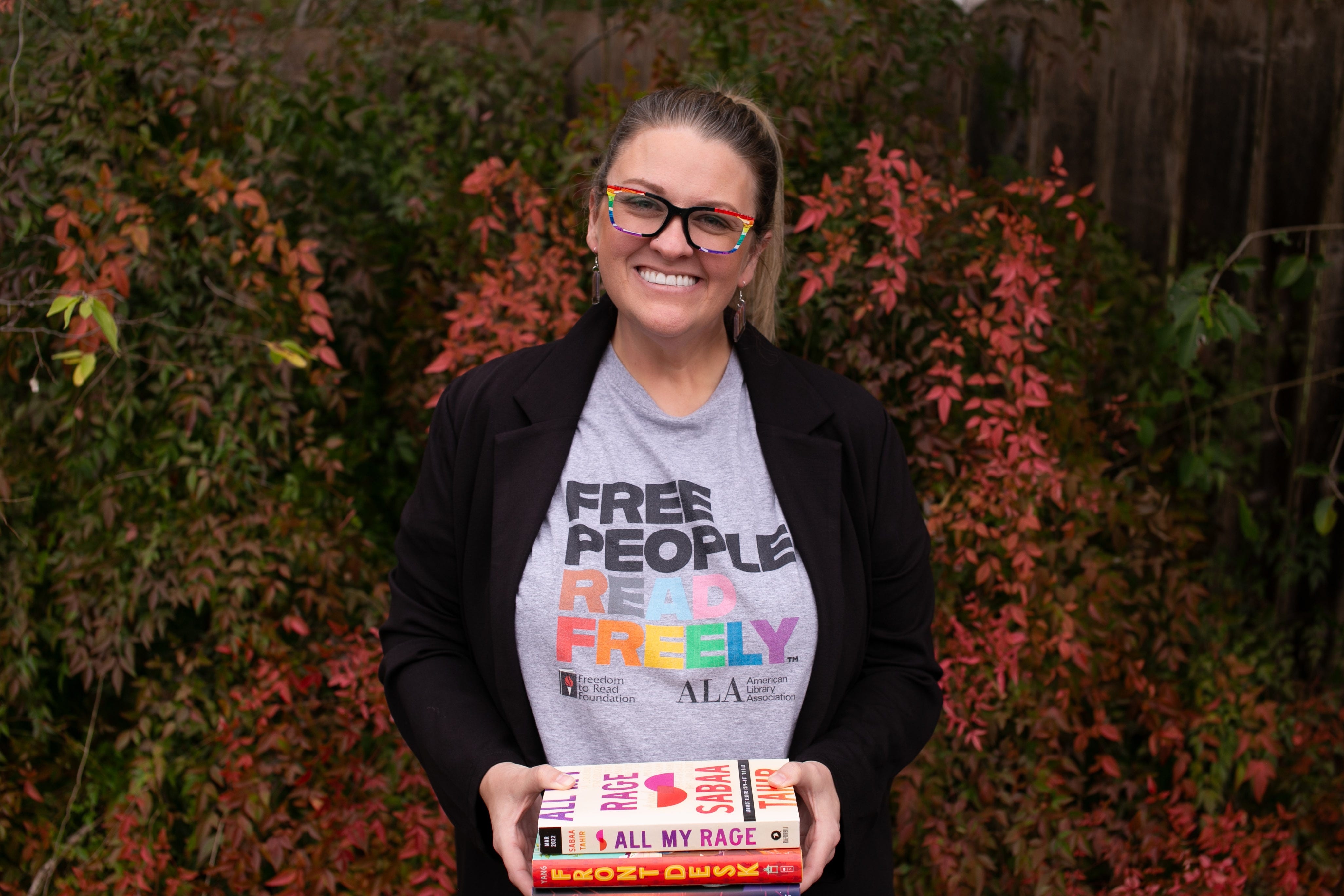
This spring, Texas Freedom to Read Project reported on one of the most shocking and wide-ranging cases of school library censorship we have encountered yet: New Braunfels Independent School District in Central Texas, where political pressure led to the removal of more than 600 books from the district’s high schools and 800 from its middle schools. That was in addition to a separate list of 455 books that were flagged as part of an AI review, of which nearly half—including books like A Streetcar Named Desire and On the Road—were ultimately removed.
The story received statewide, national, and even international coverage, but also pushback. Some critics online suggested that librarians had removed the books as a form of “malicious compliance” to make the district or Texas lawmakers looks bad. Others attempted to downplay the removals, suggesting they were just part of the librarians’ routine maintenance of their collections.
In fact, district librarians were under pressure all year long—not just from the district, but from social media activists and local politicians as well—to remove books, against their training and professional judgement. That pressure was both professional and personal, and was compounded by the effects of laws passed in the last state legislative session, especially Senate Bill 12 and Senate Bill 13. And the book removals were only part of the story.
Librarian Amanda Hunt was one of the librarians responsible for creating the spreadsheet that sparked our initial reporting on the district. She left the district at the end of the school year, and I interviewed her over Zoom last week.
Hunt is an award-winning school librarian with an engaging social media presence. This summer, she started a podcast, The Library Stage, which celebrates the creative ways school librarians are encouraging literacy, incorporating ed tech, and developing interesting programming for their students. During the first part of our conversation, we talked about the mass removals in New Braunfels ISD. In Part 2, which I’ll post later this week, Amanda detailed the personal attacks she faced over the course of the year.
Below, you can watch Part 1 of our conversation or read a transcript (lightly edited for clarity).
Anger & Clarity: Good morning, Amanda. You’re a school librarian in Texas. You have previously worked in New Braunfels ISD in Central Texas. You’re also very present online. You do these really great book reviews, and in them, your passion for reading and for literacy comes through. You’re a model for readership as a librarian. I saw an interview where you talked about the importance for librarians of keeping up with the publishing industry, and it’s clear that’s not just a professional responsibility for you; that’s actually something you take joy in. And you’ve been winning awards! You were named a 2026 Mover and Shaker by Library Journal, and ISTE named you a “Librarian to Watch” earlier this summer. Congratulations on that!
Amanda Hunt: Thank you.
And you just started a podcast, The Library Stage, that’s meant to highlight the great work that other librarians are doing.
Absolutely.
But this year has not been all sunshine and light for you, and we’ll talk about some of the things that you’ve personally gone through.
But I also want to talk about some of the laws that are making the work of librarians more challenging here in Texas.
Before we do that, I want to give you a chance to introduce yourself. What brought you to your work as a librarian? What keeps you doing this work?
Absolutely. This has been the hardest year of my life, even awards notwithstanding. I am—was—a middle school library media specialist in the district where I grew up, New Braunfels ISD, and I currently am a resident of New Braunfels. And last year, when Senate Bill 12 and Senate Bill 13 went into effect, I had no idea the ramifications that was going to have on my community, on our district, with my students, and ultimately my job.
I was as outspoken as I felt I could be, talking about some of the things that were happening that I felt were handled in the wrong way, that went against our school board policy, that were targeting certain groups of people—to make sure that we were seeing less and less of their books in the shelves—and I had a platform and no one else in my district did.
And I felt a responsibility to use that platform as best I could to share what was happening. I was employed by that district. But at the same time, I felt like everything we’d ever been taught in library school, in professional development, in conferences we went to, this went against all of that, against everything that I had been taught as a library media specialist. So I felt like that needed to be shared and documented. And I so appreciate the work that Texas Freedom to Read Project has done to help keep all of that stuff documented for the future.
A volunteer with Texas Freedom to Read Project filed a public information request earlier this year, asking the district for titles that have been removed, and we received back information that hundreds of books had been “weeded.” About 600 books were removed from the high school, and about 800 were either removed from middle schools or sent up to the high schools. The explanation given in most cases was: “Weeded: Senate Bill 13.” That was in addition to another 455 titles, a separate list of books, that were flagged with AI as being in possible violation of Senate Bill 13, and about half of those were eventually removed. Can you explain what was going on there and what you saw as a librarian in the district?
I had a front row seat to all of this because at the time I was the secondary lead librarian for the district. It was my job to do research on what other districts are doing and how they were handling it, because we were given zero direction on how to take all of this. We were doing the best we could using sources from Leander ISD, like Becky Calzada, and then Northside ISD. We were just trying to see how everyone was handling it.
And then we took what we could and shared that with our district. We felt like our superintendent, our chief of schools, and academic officer were all on the same page. However, upon attending the first board meeting where this was brought up in August, it was clear that the board was not on the same page in terms of trusting librarians or leaning on our expertise and training.
In September, when Senate Bill 13 went into effect, we thought we would get our first round of books approved. Due to some bonds that we had gotten, we had a good chunk of money that needed to be spent at the high school level. We went in with around 12,000 titles. And that was overwhelming; I understand that. However, even weeding them down, taking out the bond books to be approved at another time, the purchase still was not getting approved. And that’s when we started to think, “Wait. This is going to be a bigger deal than we thought it was.”
In October, the school board decided to shut down the secondary libraries to do an audit of our entire collection, which went beyond the scope of what Senate Bill 13 called for—everything before September 1st was supposed to be grandfathered in. Obviously, closing our libraries completely, not giving kids access, making it seem that the library is a bad and scary place, was horrifying.
It happened right at the time of American Association of School Librarians (AASL) conference in St. Louis, where I was supposed to present on the second edition of the school library standards that I had helped curate and create. And so those two things happening at the same time—I’m somebody that knows library standards so well I helped write a book on it, and they don’t even trust me to purchase titles for my middle school library. Those two things were just so insane to me, happening at the same time.
Our community came together and showed up at a special board meeting at the end of October and demanded that the libraries be reopened. And the libraries were reopened, and a lot of community members thought, “We won! The libraries are back open!” But really it was just the beginning.
The school board decided to use an AI tool—several AI tools, such as Bookmarked—instead of trusting certified school librarians. Every single one of our librarians has a master’s degree. That is a requirement to be hired in the district. So it was just a slap to the face. And we continued to see reports sent to us with books had been flagged in AI, and they were titles like “Wonder” by R. Palacio that should not be flagged. So we were scrambling.
And, I’m sorry, but the middle school had it the worst. It is a really hard age to serve: we have little 11-year-olds coming in, all the way up to my 14- and 15-year-olds that are ready for more mature content.
We have YA stickers on books in the middle school that have that young adult content in it. We do a lot of training at the beginning of the year, teaching students, “This is how you choose a book. Talk to your parents.” And Senate Bill 13 was written with parents in mind to give them the power to see their kids’ checkouts and block certain titles. But our school board believed they were charged with this task.
So for months we continued to pull books off the shelves and send them to the high schools. The high schools pulled books. We had all of our AP titles locked away in closets at the high schools, and at the end we had no transparency with our public.
Like I said, most people were like, “Oh, the library’s open. Y’all are all good. Thanks, awesome!”
And really it was so hard to not be able to share all of the things that were happening. I had stacks and stacks of books lined up in boxes to send to the high school or to “weed,” and it took until the May board meeting for the district for the board to agree to purchase a bare minimum list of titles. And by then it was too late, we had already spent our budget. So we went a whole school year without our students having access to new titles, and that was hard.
And then at the June board meeting they decided to go against the parent and community committee for our first challenge—we’ve had our first challenge in twenty-five years. It was for Allegedly, by Tiffany D. Jackson, and the committee wholeheartedly, unanimously agreed to keep that title at the high school, and the board overrode them and decided to ban it.
So that’s kind of where it is right now. But I am no longer with the district, which is why I feel more confident being able to speak on what happened. But again, there’s so much that occurred during this past school year that was just mind-boggling, and that no one really knew about. And it’s because of the fear of us losing our jobs that we couldn’t share any of it.
I want to drill down on the details of the books that were weeded. You said you were you were asked to pull books throughout the course of the year, and they were listed as weeded. Are those the books that are showing up on our public information request as “Weeded: Senate Bill 13”?
Yes. They started the year with this idea, in October after the libraries closed, that they wanted us to keep track of every single book we took out of our circulation.
And at the time, I thought, “Oh my gosh!”
As a librarian, we’re used to the autonomy of being able to decide what is weeded and not give an explanation. But this spreadsheet is so detailed. We had to keep track of the ISBN, the title, the author, the series, why we weeded it, who weeded it, a timestamp. We had to do that for every single book.
It was because of Senate Bill 13, or because the other middle school librarian and myself were on the phone with each other every single day, saying, “Okay, I saw this title, and guess what? Now Mackin or School Library or Follett say it should be 10th and up.” And when we purchased it, it was recommended 9th and up, or 14 and up, or 8th and up. So we were constantly having conversations of whether to age up.
We had been told in meetings, “We are erring on the side of [being] conservative. If you think that even one review or suggestion from a publisher says it should be older, then it’s going to go to the high school.”
So not only were we told that, we were also self-censoring a little bit because we were terrified. We thought, “We’re going to lose our job if this book …”
But, yeah, we had to list the reason for every single thing. So you’ll see a lot of them are listed “Re-placement,” which means that we sent it up to the high school.
Now: Is that banning?
I think so, because I’m taking away access to my middle school students, for which the age does fit their needs. A third of my campus turns 14 years old in a school year, and we were taking hundreds and hundreds of titles away from them.
Yeah, I mean the books on the middle school list include Hemingway, and I started reading Hemingway in seventh grade. My grandmother gave me a set of his books, and that’s part of what set me on the path to being a reader for the rest of my life. I was like, “Wow, I’m reading serious literature, I feel like I can connect with the great big world.”
Exactly. And the funny thing about that is, seven years ago, our reading curriculum specialist specifically told me and the other middle school librarian that we needed to create a “Classics/AP literature” section in our libraries because our district wasn’t producing any National Merit Scholars, and it’s because they weren’t reading critically and reading difficult texts at eighth grade, when they were ready to do that. And so we did. We spent a bunch of money, bought all these books, and then fast forward seven years, and they said, “Anything labeled adult, anything classics, it’s going up.” And even then, I don’t know if they got to have them at the high school.
Because now it looks like the AP lit books at the high school level are restricted, and we don’t know if they have access to those, right?
Right. I believe now they’re out of the closet, but they are kept restricted, and you have to, like, prove that you’re in an AP class or something ridiculous like that.
And just to clarify: You felt pressure to age books up. Was this something you had felt in previous years?
No.
So this was a new thing. And this was not your normal weeding routine?
No!
And at the time, I thought, “Oh my god!”
Literally all year long I was like, “That spreadsheet is my op. It is taking up so much of my time of the day.” With this whole process, I didn’t get to do programming. I didn’t get to do fun events that I normally do. This whole thing took up every second of my life and then some outside of work. And so I hated the spreadsheet.
But then at the end, when y’all were able to do a public information request for it, it was very handy because it does have every single book on there that we were supposed to remove. I did. I’m hoping everyone else did too, so we could really see a full picture of what was taken out.
But no, previously, if a book needed to be weeded, I was trusted as a librarian to handle that myself using my professional judgment.
Okay, I just want to make it clear and get it on the record: Does the process that you engaged in this year reflect your expertise, your experience, your professional judgment?
No.
It was like we were in trouble constantly. Every meeting we had, it was like we were in trouble.
Me specifically, because I’m going to push back based on the things I’ve been taught. And having grown up in this community, I know these books they’re making me pull have been on my shelves for 10 and 12 years with no complaints and no issues.
And all of it just goes to show that it is very politically motivated. It is not just about the books. I think it was just the perfect storm. Senate Bill 13 dropped at a time when my board wanted to make a statement of some sort. A few on the board are politically motivated and are running for other offices, and so I feel like that had a bit to do with it. But it was just the worst timing across the board. I’ve never ever had to follow any of these procedures or protocols in the past, and we hadn’t had a challenge in 25 years.
When our story dropped, it got a lot of a lot of responses. One set of responses has been to blame the librarians for these mass removals. On one hand, you had you had people saying this was malicious compliance, that librarians were pulling books in order to make the law look bad or to make the school board look bad. Another group said this was poor judgment on the part of librarians. I actually had a state rep on social media say that this showed that AI can do the job better than librarians can. How do you respond?
To the first point, you’ll see on my social media that I, more than anyone, hate Senate Bill 13 and Senate Bill 12—for different reasons. And I don’t know of any other librarian in the state of Texas that enjoys this bill or thinks this bill is a good idea. But never would I pull books to the detriment of the students that I’m there for, the students that I fight for, that I work with every single day, that I see and I counsel and I talk to and I recommend titles to. Never would I have them be the victim of me trying to prove a point.
The bill honestly speaks for itself. Anybody that reads that bill will see it is the most vague, ridiculous thing. Just talk to a librarian. I don’t need to pull books to show how crazy that bill is.
And then, as to the idea that AI can do it better… Well, I have many, many spreadsheets from this past year that show just how untrue that is. Even using the Senate Bill 13 language in the AI tool we started with in the district that was made up by one of our technicians, it proved to not be good. We went to Bookmarked, which is also skewed for its own reasons. And then we went up to Luma, which is an AI tool out of Florida. They all made mistakes. No matter how fine-tuned we got, no matter how many iterations of this AI that we created, or that we used, or that they spent I don’t know how much money on, it continued to make mistakes, and it continued to show it was pulling from, like, Amazon and Goodreads reviews instead of actual literary journals we use.
AI also doesn’t have the know-how of our community. It doesn’t know that we look for gaps in our collections. We look to make sure that every student is represented on the shelves, as well as students getting experience from other people and other walks of life that they might not know about, and that creates empathy. There are a lot of things we take into account that AI simply just cannot do.
That makes sense. And even the list of 455 books flagged by AI—it’s such a weird list, right?
It is. It’s so random.
It has things like A Streetcar Named Desire. It just didn’t make any sense to me.
It did not. Agreed.
So, we know what happened to the books sent to the high schools. Do you know what happened to the books that were removed? Where are those books today?
In a normal year, when I weed, I put the books on a cart. I put them out in the hall for free books for kids. I put them in the teachers’ workroom if they want free books. I use them for low-tech makerspace activities, or I use them for blackout poetry in April. So we use the books in a lot of ways.
However, when we’re pulling these books now because of “inappropriate content,” I can’t put them in the hall for free. I can’t give them away to teachers. I can’t use them. So we had to “black bag” them, which is getting black trash bags, marking out the barcode and any identification, putting them in there, and then sending them to the trash. And that’s what we did.
Can you talk about the impact of your district’s response to the law on the kids of New Braunfels ISD?
It was really hard when the library was closed.
And then when it reopened, to have so many kids say things like, “Oh, the library’s closed because Miss Hunt has inappropriate books in there.” Or, “We can’t go in the library because we’re banning books.” Or, “Miss Hunt, I know you banned Harry Potter or Diary of Anne Frank.”
And it was just all misinformation. Obviously, they’re repeating it from their parents, from their friends. We never had clear communication from the district to parents. Throughout this entire year, this process in general, we were not transparent.
And so we had rumors—that we still have. They’re still saying all kinds of horrible things about me, about librarians in general: that we have this nefarious plan to expose kids to inappropriate content all the time without actually taking any of these books and reading them in their entirety and taking them as a whole and looking at literary merit and all of that stuff.
So that was hard for me to have to constantly debunk these crazy conspiracy theories from students. But then my circulation numbers never recovered after we were closed. There were too many rumors, I guess, of what they could and could not check out. There was less time coming to the library because we had been closed, and then my teachers got off of a rhythm, and then we had testing.
I am used to having 11,000 to 13,000 books circulated in a school year. I think I had 8000 this year, and that’s the lowest it’s ever been. And so that was really hard.
But I also have my students that love reading, whose parents support them reading. I even had several of them speak at the board meeting when we were reopening the libraries. I have one in particular that did her end of year Eco-Art project surrounding censorship and book banning, and she is fantastic and so well spoken. And because of this happening, she has now found a cause that she wants to champion and fight for, and has made it very clear that she is willing to go speak at anything, protest anywhere.
And I am just so grateful to my library aides who saw all of this happen real time, who had to help me pull these books, who were so mad they would write letters to the newspaper about how insane this was because they saw it. And they were going home and telling their parents, and their parents wrote letters to the board. They were really the only ones who knew, because the other kids weren’t coming in as often. Even though I do have big readers, they didn’t know the ins and outs of what it looks like to ban and remove hundreds of titles. So my group of library aides this year, they’ll have that experience, and all of them feel very passionate about not wanting to have any of this happen again. They’ll have that experience going into life for forever and remember it.
But it was just really, really hard all the way around to see reading be so politicized, and these kids are the victims of it, unfortunately.
Great job, Amanda. Thank you for speaking out persistently, and especially now as so many more folks need to understand what is happening!
As a resident of Comal County, I say thank you for speaking out as a professional librarian in our local schools.